Faculty focus: Jessi Cisewski-Kehe and the search for other worlds

Department of Statistics Assistant Professor Jessi Cisewski-Kehe
From actuary to academic
In 2007, as she began her graduate studies in statistics at the University of North Carolina-Chapel Hill, Cisewski-Kehe initially hoped to pursue a postgraduate career as a research actuary. But she enjoyed the graduate school atmosphere so much that, she said, she knew “within two to three weeks” that she would be staying in academia longer-term. After obtaining her PhD from UNC-Chapel Hill, Cisewski-Kehe took a three-year visiting assistant professorship at Carnegie Mellon University (CMU). “I was free to pursue any research interests,” she said, which allowed her to explore and dive deeper into the growing field of astrostatistics, working with an established group of astrostatisticians. After all, she was fascinated by astronomy, and astrostatistics offered opportunities to apply statistical techniques in new and innovative ways. At CMU, she built a strong foundation of work and established herself in the field. After three years at CMU, Cisewski-Kehe moved on to Yale, where she served as an assistant professor for five years, again working with leaders in the field of astrostatistics, including Professor Debra Fischer, one of the pioneers in the search for planets orbiting other stars. Then, in 2020, Cisewski-Kehe and her husband were ready to return home to the Midwest (she is originally from Minnesota; her husband from Iowa) to be closer to family. She was particularly attracted to UW–Madison for several reasons, including the reputation of the Department of Statistics as a top program nationally, the range of research interests among the faculty, as well as a welcoming community of students and staff. When she was offered a position as an assistant professor at UW–Madison, she took it.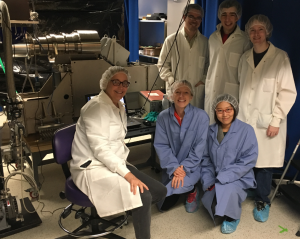
Cisewski-Kehe (seated in blue, center) at Yale University with Professor Debra Fischer (left) and colleagues by the EXPRES (EXtreme PREcision Spectrometer) machine. Photo courtesy of Cisewski-Kehe.
Data from space
As Cisewski-Kehe’s career trajectory progressed, so did the field of astrostatistics, which dates back to the early 1990s. The role of astrostatisticians is to use or develop advanced statistical techniques on astronomical data to “quantify the uncertainties in theoretical models and turn raw numbers from observations into something useful,” according to the Harvard & Smithsonian Center for Astrophysics. And as it turned out, for Cisewski-Kehe, the world of astronomy was something of a statistician’s dream, offering a diverse assortment of data. “You have functional data, you have image data, you have regular numerical data, you have categorical data, you have time series data, you have point process data…it’s just everything,” Cisewski-Kehe said.“If any statistician is looking for an application of some method or theory, there’s probably going to be something in astronomy suitable for them.” Jessi Cisewski-KeheOne application of statistics in astronomy involves revealing previously undiscovered worlds. A group within the astrostatistics community, including Ciewski-Kehe, are dead-set on detecting exoplanets—or planets outside our solar system—that may be similar to Earth. In 1995, researchers detected an exoplanet orbiting a sun-like star for the first time: 51 Pegasi b. NASA says that discovery “made us question what we knew of our universe and launched the search for new worlds.” That breakthrough was made possible by data; specifically, data collected over time using the radial velocity (RV) of a star, which can provide clues about the presence of orbiting planets. If the star’s RV data show a characteristic wave pattern, it can indicate the periodic tug of a nearby planet. Today, the RV method is one of several methods used by researchers like Cisewski-Kehe to detect exoplanets, and in total over 5,000 have been identified.
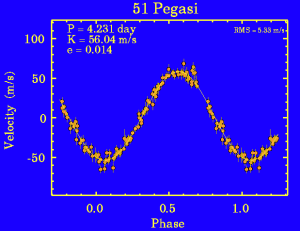
The radial velocity graph of 51 Pegasi b, the first exoplanet ever detected, shows the sinusoid shape now recognized as typical for a star with an orbiting exoplanet. Image courtesy of The Planetary Society.
Working across disciplines
Through her work in astrostatistics, as well as teaching STAT 998 (Statistical Consulting), Cisewski-Kehe has grown to appreciate the importance of interdisciplinary work for solving complex problems. She said when statistical experts work with other researchers, it benefits both sides. “It’s good for statisticians because we come up with new, interesting problems that we might not have ever had to deal with otherwise,” Cisewski-Kehe said. “And it’s good for the domain experts because having people trained in statistical thinking, in dealing with uncertainty and data, is useful for them to come up with correct conclusions or correct inferences.” Looking ahead, Cisewski-Kehe remains focused on trying to detect Earth analogues, working with statisticians and astronomers around the country and world. But even if planets similar to ours in terms of size and composition are discovered, she emphasized, the question of the existence of life on other planets still “presents a lot of interesting challenges.” That’s in part because we have what she called a “sample size of one”—Earth is the only planet known to harbor life, making generalization about other planets inherently speculative. Regardless, as new telescopes and other tools collect vast amounts of data, the demand for statisticians to make sense of that data—and use it make new discoveries—will continue to rise. Cisewski-Kehe invites interested students and scholars to explore the field of astrostatistics in this exciting time.For more information about Jessi Cisewski-Kehe’s work, visit her website. Written by Thomas Jilk, marketing & communications specialist.