Professor Garvesh Raskutti steps into the role of Statistics department chair
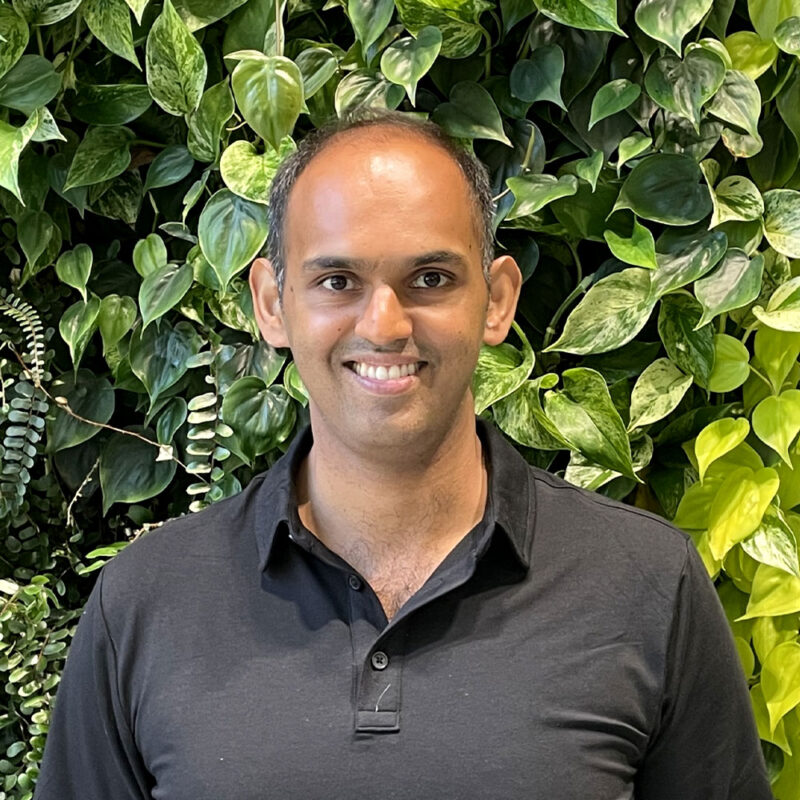
Raskutti sees promising opportunities ahead as the Department of Statistics joins the College of Computing & Artificial Intelligence.
Throughout his career, Professor Garvesh Raskutti has been devoted to using statistics and computing to tackle cross-disciplinary problems — whether bringing machine learning to cancer research, studying protein-folding with biochemists, or unpacking the uncertainty inherent in today’s large language models.
Now, as chair of the Department of Statistics, Raskutti will continue to build on the growth in both student enrollment and faculty hiring within the department in recent years. At the same time, he said, he is focused on leading the department’s integration into the College of Computing & Artificial Intelligence (CAI), launched in July. He said joining CAI presents “great opportunities” for Statistics to serve as a foundational discipline in an age of rapid change.
“People have a lot of uncertainty and mistrust in AI today,” Raskutti said. “We have people who understand how these models work, but also the tradition of working with others in different disciplines and across society. That puts us in a great position to build connections between statistical methods and people’s real interactions with the tools.”
Building on transformative growth
Raskutti steps into the role of chair at a time when the department has expanded rapidly in both size and scope. “We have one of the largest and broadest departments in the country,” Raskutti said, and with the transition to CAI, “We want to retain the core and foundation of what we are as a department but also take advantage of opportunities to hire and expand.”
Over the past decade, the number of faculty in the department has nearly doubled. When Raskutti arrived, there were only a handful of junior faculty; today, the department includes roughly 20 junior and 20 senior members, representing a wide variety of focus areas within statistics and data science, such as AI explainability, uncertainty quantification, and applied statistics for climate science and biology. “The innovative ideas of our junior faculty are really exciting,” he said.
On top of that growth, CAI aims to hire 50 faculty members across its three departments in the coming years, including some with joint appointments across campus. Raskutti said the goal is for the department to be a hub for statistical work that is “current and relevant,” especially as AI reshapes how people interact with data.
We have people who understand how these models work, but also the tradition of working with others in different disciplines and across society. That puts us in a great position to build connections between statistical methods and people’s real interactions with the tools.
He added that the department is also re-examining how it educates students in the AI age. Like departments across campuses nationwide, Statistics is rethinking how to evaluate student work to reflect the current moment. “We are thinking about how we can modify exams or evaluations to be useful in this new world, working closely with Computer Sciences and the Information School.”
Industry connections are another priority for Raskutti. New undergraduate electives led by are helping students translate academic work to industry application, with hopes for master’s- and PhD‑level versions in the future. As students’ relationship with education evolves, the department is exploring more flexible ways for students to access courses while keeping the curricular foundations intact. As Raskutti noted, in the age of AI, “foundations are more important than ever.”
A data-driven hub in CAI
Raskutti sees Statistics as a key discipline for this moment. The field has “two great complementary sides,” he said — the computational and mathematical side, and the tradition of working with people across fields. That tradition was brought to UW–Madison by the legendary George Box, the professor who founded the Statistics department in 1960s, and it is more important than ever as researchers and students in every discipline make sense of AI’s role in their work.
The same outlook connects to CAI’s mission of expanding access to AI and computing. Raskutti said Statistics can contribute through accessible introductory courses, building on the approach of the Data Science major, which is now the second most popular on campus. Statistics has a reputation for being hard, he acknowledged, but “everyone already makes data-driven decisions all the time, and we can teach statistics with anecdotes and humor.”
As CAI embarks on its founding year, Raskutti hopes the Statistics department can serve as a hub within the college, grounding new innovations in rigorous methods and enabling trustworthy, reliable uses of the technologies that are transforming education, research, and the world at large.
Explore the full Statistics faculty or learn more about the College of Computing & Artificial Intelligence on its website.