Teaching Faculty John Gillett makes machine learning click, with humor and humility
What does it take for humans to learn how machines learn?
By Thomas Jilk
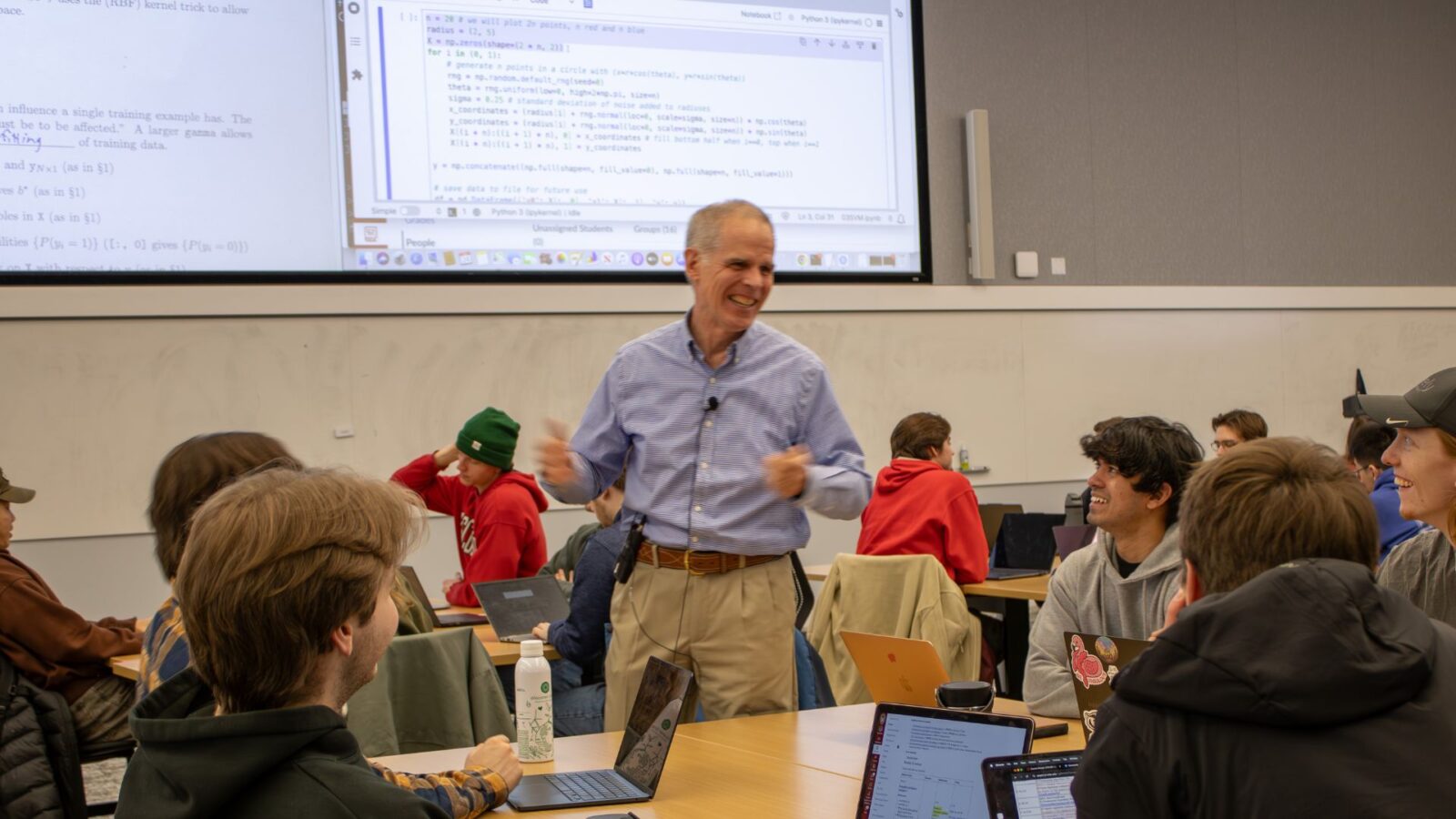
First, a firm understanding of statistics and computing is required, as Statistics Teaching Faculty John Gillett knows. He brings that understanding — along with healthy doses of humor and humility — to his courses, where he shapes how thousands of UW–Madison students first encounter machine learning.
“It turns out I’m a good beginner at statistics, computer science, and math,” he said, “and then it turns out I’m also a competent teacher.” That’s putting it mildly, according to students, who appreciate Gillett’s uncanny ability to make technical concepts approachable and even fun. He has also been an important architect of the department’s curriculum over the past two decades, creating several new courses at a moment of rapidly accelerating student demand –– after launching in 2020, the department’s Data Science major became one of the fastest-growing majors on campus.
Today, as the Statistics department prepares to join the College of Computing and Artificial Intelligence (CAI), Gillett is grappling with the impacts of AI in the classroom. He called generative AI a “power tool” but admitted it initially had him feeling “insecure as a teacher,” since it could solve homework problems for students while allowing some to avoid the trial-and-error process central to learning. Against this backdrop, Gillett is both enabling students to embrace AI tools and pushing them to think for themselves. His perspective, shaped by a career of adaptation, reflects a deep commitment to preparing students for a field changing faster than ever.
From IBM to UW–Madison
Gillett’s route into teaching started after what, at the time, he considered his “first professional failure”: starting but not completing a PhD in mathematics.
Shifting his focus to the fast-growing field of computer science in the early 1990s, Gillett spent formative years at IBM’s Watson Research Center, where he worked alongside a high‑level technical team. (He referred to himself during this time as a “programmer grunt baby”). There, he learned how to work effectively with large data sets via scientific and parallel computing, skills that would later shape the courses he built at UW–Madison.
Enhancing the Statistics curriculum
In 2009, Gillett began as a single‑course lecturer in the Computer Sciences department, teaching Numerical Methods, before moving into the Statistics department as it expanded its focus on computing tools and technologies. In the ensuing years, Gillett created an R programming sequence (STAT 303, 304, and 305) and later the Data Science Computing Project course (STAT 405/605), in which students work collaboratively to collect, manage, and analyze large data sets.
When the department’s previous machine learning instructor departed, he took on Introduction to Machine Learning (STAT 451), developing a version of the course that has provided thousands of students across the School of Computer, Data & Information Sciences (CDIS) with their first taste of machine learning concepts.
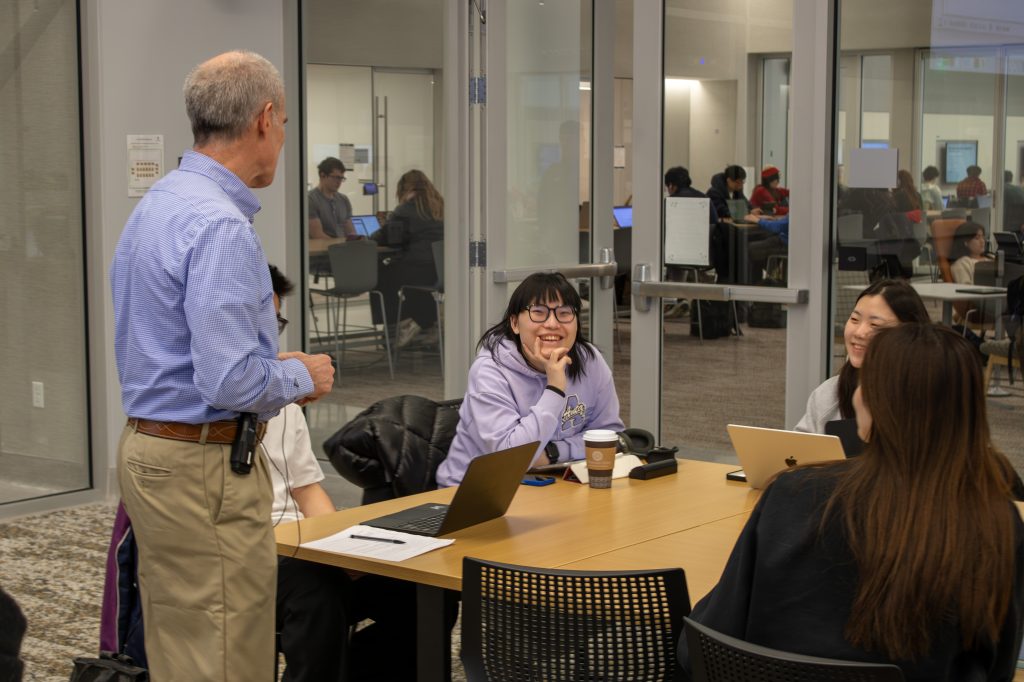
In addition, Gillett developed an innovative Special Topics in Statistics (STAT 479) course in 2022, partnering with the Center for High Throughput Computing to offer undergraduate Statistics students hands-on education and experience with high throughput computing for the first time. In the course, he saw students with little programming experience become “less and less intimidated by big data sets and computations that they wouldn’t have been able to consider otherwise,” he said.
Throughout his teaching career, Gillett explained, he has learned how to tell when students find a course worthwhile. Whether the topic at hand is introductory statistics or high throughput computing, “If we’re chatting and they’re asking questions and we’re going back and forth, that’s when the class works,” he said.
“Striving for understanding” in the AI era
The rise of generative AI has impacted Gillett’s teaching in ways he never imagined a few years ago. He’s candid about the challenges, with AI able to answer many of his homework problems, sometimes “better than my solutions.” The irony is not lost on Gillett that machine learning-based technologies are forcing him to rethink his approach to teaching how those technologies work in the first place.
Nonetheless, he encourages students to use AI as a “power tool,” while insisting they stay focused on the concepts underlying today’s impressive tools. “Students should use AI,” he said, “but they should be striving for understanding. Never accept a black‑box answer.” It’s all part of the process of students “learning to think for themselves and make sound decisions,” which overreliance on generative AI can undermine.
As a result, Gillett is adjusting how much weight he gives homework in his grading structure, as generative AI makes homework a less reliable indicator of student understanding. He is also shifting more emphasis onto in-class project work, encouraging collaborative learning and problem-solving (with the help of AI) while enabling students to defend conclusions and decisions they make in an in-person setting, just as they would in future professional roles.
This approach is designed to help students encounter what Gillett called the “why it’s not working” moments, the messier parts of learning that involve overcoming intellectual roadblocks. Those moments, he says, are where real understanding takes root. And in the end, the students who learn to navigate those challenges with confidence will be the ones best prepared to wield AI — the ultimate digital power tool — with judgment and purpose.