Sports Analytics Club enables students to turn data into game-changing insights
By Thomas Jilk
Today, even a single NFL game generates a staggering amount of data: Ten times per second, the league tracks the location, speed, and acceleration of every player on the field. Multiply that times 272 to account for all regular-season games, and the NFL has a gold mine for coaches and analysts seeking even the slightest edge.
This explosion of data reflects a broader trend across the sports world. With more access to rich datasets, anyone with curiosity and statistical skills — including UW–Madison students — can uncover insights that help teams win. The growing Sports Analytics Club at UW–Madison is doing just that, led by its president, Statistics and Computer Sciences major Shekhar Shah x’27, and faculty advisor, Assistant Professor Sameer Deshpande. Founded in 2023, the club has seen a rapid increase in interest, not just among Statistics and Data Science students, but also among students in business, engineering, and beyond.
“It’s all about getting to know people who share a similar niche interest and working towards a common goal,” Shah said. “You’re not expected to be able to build a predictive model with sports data the minute you join,” he added. “We’re looking for people who are into sports and curious about how to find an edge, whether to win arguments with friends or just to know more about their favorite team.”
The NFL Big Data Bowl
One of the club’s marquee activities is its participation in the NFL Big Data Bowl, an annual competition hosted by the league in which participants analyze real NFL tracking data to uncover strategic insights. This year’s competition, with a submission deadline in mid-December, focuses on making predictions about player movement during passing plays specifically. As the prompt instructs, “participants will predict player movement by using data before the football is thrown to produce insights on where players will move while the football is in the air.” For example, are certain receivers more likely to get open when they run a particular route? Do certain safeties close on the ball faster than others? How much faster?
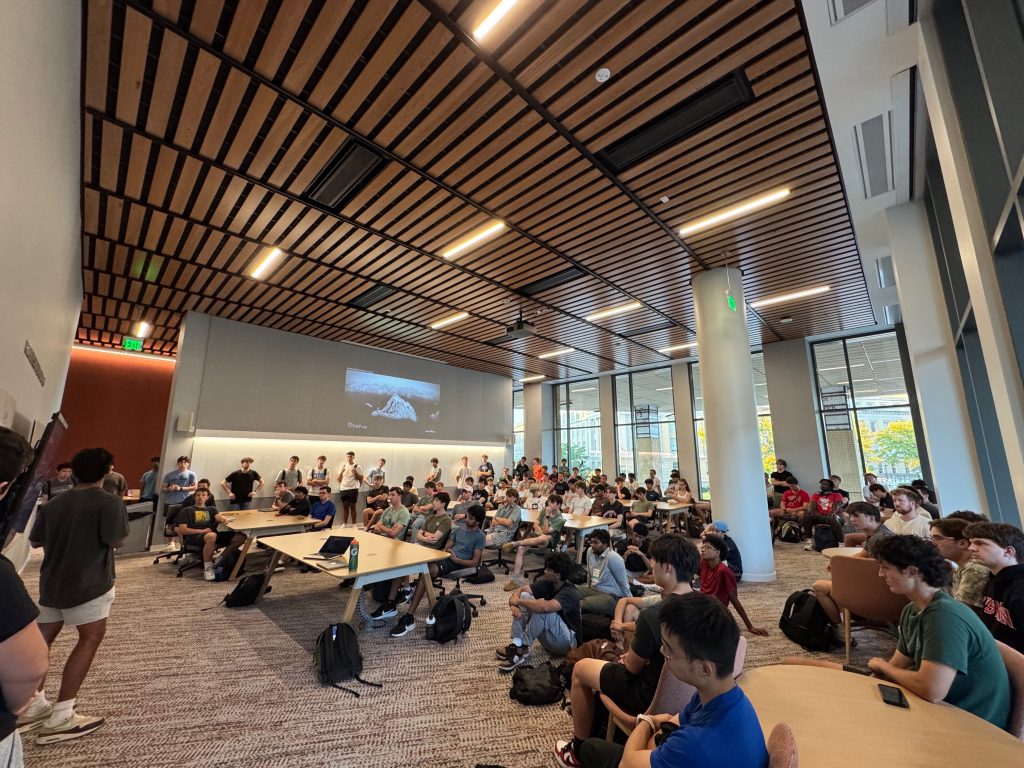
At an October club meeting in Morgridge Hall, about 40 students gathered to brainstorm project ideas. Prof. Deshpande, who teaches a sports analytics course in the Statistics Department and was a finalist in the inaugural Big Data Bowl, emphasized the importance of presentation in students’ submissions: “It’s about how you package it and how you sell it that really matters,” he told the group. “What you really need is a good question and a compelling story. They are looking for ideas that can be explained to fans.”
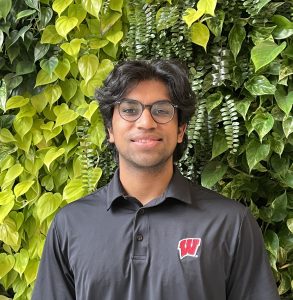
Shah knows firsthand what it takes to succeed in the competition. Last year, he and Jack Sullivan ’25, a Data Science major, earned an honorable mention for their project “Cat and Mouse: Motion vs. Defensive Alignment,” which analyzed how pre-snap motion influences defensive positioning. “That winter break was a grind, in a good way,” Shah recalled. “We were literally drawing X’s and O’s on the whiteboard, trying to identify what we were going to predict and analyze.”
Collaborating across campus and beyond
The club’s reach extends beyond competitions. This semester, members including Shah are working directly with the Wisconsin football team on recruiting and personnel analytics. “The football team has given us a couple topics that they want us to research, and we’ll get the chance to present that later in the semester,” Shah said. (The work focuses on transfer portal strategy and recruitment.)
“How can we use the numbers to give us a better sense of these players?” Shah asked. “Can we quantify production in ways that help better project high schoolers going to the next level?” As a player personnel and recruiting assistant for Wisconsin football since his freshman year, Shah has been able to contribute data-driven insights to a staff he describes as “open to different ideas.” That relationship helped facilitate the current club collaboration.
The club also partners with Badger Inquiry on Sport (BIOS), a research group within the athletics department, based at Camp Randall. Together, they have hosted events like the club’s annual March Madness prediction competition, where members build models to forecast tournament outcomes. “We plan on building that out even more this year and starting it early so people can really get a head start on it,” Shah said.
This semester, the organization has also hosted guest speakers from across the sports world, including the director of research and development for the NHL’s Seattle Kraken, Namita Nandakumar. Sessions like these give students a chance to learn from and ask questions of leaders in the field of sports data research.
Building a pipeline
Shah hopes the club can help UW–Madison emerge as one of the leading producers of talent in the sports analytics space. “A few other universities out there have a sports analytics pipeline built already,” he said. “A lot of their students work for professional teams after they graduate,” he said. “I want us to be next.”
He envisions club members following a path to professional sports teams as analysts — taking the technical and creative skills they develop in competitions and applying them at the highest levels. For students wondering whether they should join, Shah’s message is clear: Passion matters more than programming experience. “We teach technical skills throughout the semester and give walkthroughs and tutorials,” he said. “It’s a creative and innovative space.”
He added, “Bringing this community together and being part of something bigger than ourselves is a very rewarding experience.”